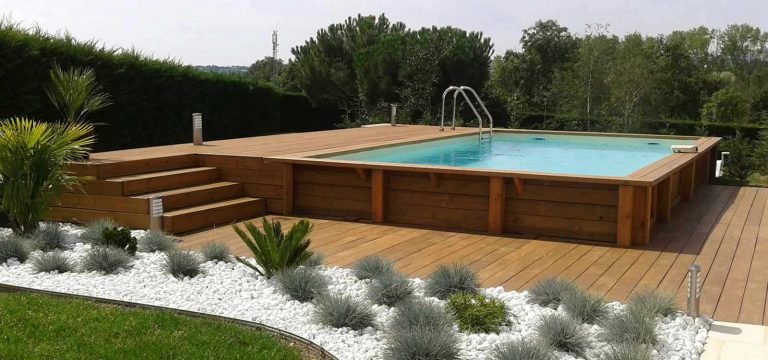
Pool water level: why it matters so much for your equipment
Your pool water level is not just a question of appearance. An insufficient level can cause costly damage to your equipment, or even destroy it for good. Here is why monitoring the level is essential — and how to never have to think about it again.
The risks of a water level that is too low
The filter pump
This is the most serious risk. A filter pump is designed to run in a closed circuit full of water. If the level drops too far, it sucks in air instead of water — this is known as running dry. Within minutes the pump overheats and the seals melt. Repairs cost between €300 and €800. In serious cases the pump cannot be repaired and must be replaced completely.
The automatic cover
An automatic cover relies on the water to unroll and roll up correctly. If the level is too low, the slats rub against the walls or floor, wear prematurely and can become deformed. Replacing a damaged automatic cover costs several thousand euros.
The salt chlorinator
A salt chlorinator needs a constant water flow to work properly. A level that is too low reduces this flow and can trigger safety alarms. In extreme cases the chlorinator can be damaged or treat the water ineffectively, leading to algae growth.
The skimmers
Skimmers draw in debris from the surface. If the water level is too low, they suck in air instead of water, creating air bubbles that disrupt filtration and can damage the pump.
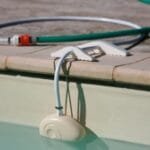
Protect your equipment this season
NivOmatic keeps your pool level constant 24/7, with no electricity and no supervision. Installed in 2 minutes. Made in France — €129.
Free delivery in France · 2-year warranty · After-sales service in France
The risks of a water level that is too high
A level that is too high causes other problems: the skimmers no longer work efficiently because the intake is submerged, filtration deteriorates and the chemicals are diluted. Not to mention the risk of overflowing, which can damage the terrace or garden.
What is the ideal water level in a pool?
The optimal level is between half and two-thirds of the height of the skimmer opening. In practice, the water should reach halfway up the skimmer weir. Too low and the equipment is at risk. Too high and filtration loses efficiency.
Why does the level drop naturally?
Several phenomena lower the level every day: evaporation (the main cause in summer), splashing during swimming, losses through the liner, and the water drained when the filter is cleaned.
→ See our article: Pool evaporation — how much water are you really losing?
These losses are normal and unavoidable — what is less so is having to make up for them by hand.
The solution: an automatic level regulator
Checking the level by hand several times a week is a chore. A single lapse — during the holidays or a long weekend — can be enough to damage expensive equipment.
NivOmatic automatically keeps your pool level at exactly the height you have set. As soon as the level drops, it opens the water supply. As soon as the level is reached, it closes it. No electricity, no supervision, 24/7.
Made in France for over 15 years — €129, installed in 2 minutes, 2-year warranty.
Pump, cover and chlorinator permanently protected Works while you are away and on holiday No tools, no technical skills needed Lifetime after-sales service in France, spare parts available
More than 6,000 owners use it every summer.
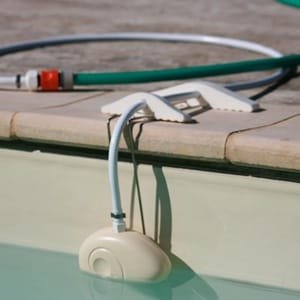
Direct from the manufacturer, free delivery in France
→ Not sure which model to choose? Read our guide
Frequently asked questions
How often should the water level be checked?
In July and August, evaporation alone can lower the level by 2 to 3 cm a week. Add splashing and filtration losses, and checking every 2–3 days is realistic in high season. An automatic regulator removes this chore completely — the level stays stable without any intervention.
How much does a pump that has lost its prime cost?
Repairs cost between €300 and €800. A complete replacement often exceeds €1,000 — not counting the time the pool is out of use during the work. By comparison, a NivOmatic costs €129 and lasts 10 to 15 years. It is the most cost-effective preventive investment you can make for your pool.
Can the level drop even without a leak?
Yes. Evaporation is the main cause and is often underestimated: up to 1,000 litres a week during a heatwave in a standard pool. A real leak shows up as a faster drop than normal evaporation — our dedicated article explains how to tell the difference.